Mon. May 25th, 2026
Spread the love

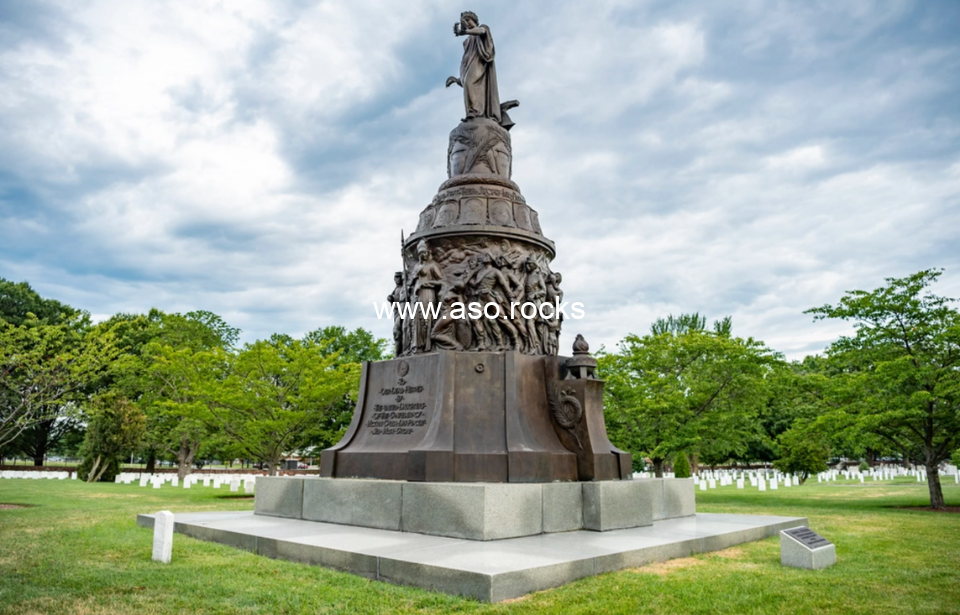
Is there a 111-year-old time capsule buried beneath the Confederate Memorial at Arlington National Cemetery? According to those who spoke with South Carolina’s The Post and Courier, such an item could exist. In fact, its existence is proven on the cemetery’s own website, mentioned within a reprint of a “seemingly unrelated historical document.”

Photo Credit: Elizabeth Fraser / Arlington National Cemetery / DVIDS / Public Domain
In 1906, with the approval of then-Secretary of War William Howard Taft, the United Daughters of the Confederacy began raising money for a monument in the Confederate section of Arlington National Cemetery. Designed by sculptor and Confederate Army veteran Moses Jacob Ezekiel, it was officially unveiled in 1914.
The monument depicts Southerners leaving to fight in the American Civil War. They’re followed by their slaves, one of whom is carrying a baby. Atop the scene is a woman who represents the American South. She’s adorned with a crown of olive leaves and carries a laurel wreath, a plow stock and a pruning hook.
Beneath the statue is the Biblical inscription, “They have beat their swords into plough-shares and their spears into pruning hooks,” as well as a circular base of shields, which feature the coat of arms of the 11 Confederate states, as well as Maryland, Kentucky and Missouri.

Photo Credit: Elizabeth Fraser / Arlington National Cemetery / DVIDS / Public Domain
The 32-foot-tall monument was among the focuses of the Commission on the Naming of Items of the Department of Defense That Commemorate the Confederate States of America or Any Person Who Served Voluntarily with the Confederate States of America – better known as the Naming Commission – which recommended it be removed.
Given its depiction of Confederate-era ideals, the aim is to have it removed by the end of 2023. However, the granite pedestal will remain, as to not disturb any of the graves around it – 482 Confederate resting places, to be exact. Given this, there are no plans to dig beneath the base.
Officials launched a public consultation period at the end of August 2023, to gather opinions about what should happen to the memorial upon its removal.

Photo Credit: Elizabeth Fraser / Arlington National Cemetery / DVIDS / Public Domain
According to experts who spoke with The Post and Courier, a time capsule sits at the cornerstone of the Confederate Memorial at Arlington National Cemetery.
Through archival records, the publication uncovered information that suggests the box was buried during construction and contains 40 Confederate-era items, including newspapers, stamps, coins, the South Carolina state flag, a plaster cast of the “Great Seal of the Confederate States,” pre-war currency and a Confederate flag with the “Stars and Bars” banner.
These records also show the time capsule may contain the “Program of the Laying of the Corner-Stone of Arlington Monument,” which contains writings about the Lost Cause myth – a claim that the cause of “the Confederate States during the American Civil War was just, heroic, and not centered on slavery.”

Photo Credit: Elizabeth Fraser / Arlington National Cemetery / DVIDS / Public Domain
Talking with The Post and Courier, a spokesperson for Arlington National Cemetery said:
“Some sources state that the Arlington Confederate Monument Association buried a time capsule below a cornerstone. The exact location is unknown. The Army will not deconstruct the granite bases in any way or conduct any subsurface disturbance.
“If the time capsule is inadvertently located while removing the bronze elements of the memorial, Army National Military Cemeteries (ANMC) will develop a plan in conjunction with the Department of Historic Resources (DHR) and consulting parties, for disposition of the time capsules.”
More from us: Hoard of American Civil War-Era Coins Worth $2 Million Discovered In Kentucky Corn Field
When approached for comment by the South Carolina publication, retired US Army Brig. Gen. Ty Seidule, who served as the vice chair of the Naming Commission, said, “I don’t know anything about a time capsule.”

The post 111-Year-Old Time Capsule Could Be Buried Beneath Confederate Memorial At Arlington National Cemetery appeared first on warhistoryonline.

By

You missed

From Tramadol to Canadian to Exol-5 The New Drug Destroying Nigerian Youths An Investigative Article .From Tramadol to Canadian to Exol-5: The New Drug Destroying Nigerian Youths An Investigative Report on the Shifting Landscape of Substance Abuse in Nigeria Nigeria faces a severe and evolving drug crisis, particularly among its youth. What began with the widespread abuse of Tramadol has progressed through mixtures like “Canadian” to newer pharmaceutical diversions such as Exol-5. This shift reflects deeper issues: easy access to prescription drugs, weak regulation, socioeconomic pressures, and aggressive street-level marketing. NDLEA operations and health studies reveal a public health emergency that threatens an entire generation. Phase 1: The Tramadol Epidemic (2010s–Early 2020s) Tramadol, a synthetic opioid prescribed for moderate to severe pain, became Nigeria’s most notorious street drug. Cheap, potent, and widely smuggled (often from India and other Asian countries), it offered users energy, euphoria, and pain relief — appealing to commercial drivers, laborers, students, and young men seeking confidence or stamina. Scale of the Problem: Millions of tablets seized annually by NDLEA. High prevalence among young males aged 15–35. Linked to increased crime, sexual violence, organ damage (kidney failure, seizures), and mental health breakdowns. Contributed to broader opioid misuse alongside codeine cough syrups. Government responses included tighter import controls and public awareness campaigns, but these only displaced demand to other substances rather than eliminating it. Phase 2: The Rise of “Canadian” (Mid-2020s) “Canadian” or “Canadian Loud” emerged as a popular code for high-grade cannabis (often indica-dominant strains) or cannabis mixed with other synthetics. It gained traction as users sought alternatives or combinations to Tramadol’s effects. This phase marked a move toward imported or locally cultivated premium weed, sometimes laced with stronger chemicals. Youths in urban centers like Lagos, Kano, Jos, and Onitsha embraced it for its perceived “cleaner” high compared to opioids. However, it fueled polydrug use — combining cannabis with opioids, sedatives, or alcohol — amplifying health risks. Phase 3: Exol-5 – The Current Threat (2024–2026) Exol-5 (Benzhexol Hydrochloride / Trihexyphenidyl 5mg), originally a prescription medication for Parkinson’s disease and drug-induced movement disorders, has become the latest pharmaceutical being heavily abused. Why Exol-5? Euphoric Effects: Users report intense euphoria, hallucinations, and a sense of detachment — making it attractive as a cheap “upper” or escape. Accessibility: Sold over-the-counter or on the black market despite being a controlled prescription drug. NDLEA has seized millions of pills in single operations (e.g., 3.1 million pills in Kano in late 2024, and over 5.6 million combined with Tramadol in other busts). Street Names: Exol, Artane, Benzhexol, “Farin Mallam” (in Northern Nigeria). Demographics: Prevalent among youths, laborers, and even psychiatric patients who divert prescriptions. Studies show abuse rates as high as 25% among certain outpatient groups. Health Consequences: Anticholinergic toxicity: Confusion, dry mouth, blurred vision, urinary retention, constipation, and in high doses — delirium, psychosis, seizures, and heart issues. Long-term: Cognitive impairment, addiction, exacerbated mental health disorders. Often mixed with Tramadol, codeine, or cannabis, creating dangerous synergies. In cities like Jos, Exol-5 sits alongside diazepam, Rohypnol, and Tramadol on street markets, easily available to teenagers and young adults. Why This Evolution Continues Supply-Side Failures: Porous borders, corrupt officials, and overproduction of pharmaceuticals enable diversion. Demand Drivers: Unemployment, poverty, peer pressure, trauma, and the pursuit of performance enhancement (e.g., for “hustle” culture). Weak Regulation: Many pharmacies sell restricted drugs without prescriptions. Online and street vendors fill gaps. Displacement Effect: Cracking down on one substance (Tramadol/codeine) pushes users and dealers toward the next available option. NDLEA reports ongoing large seizures, but the problem persists due to high profitability and low risk for mid-level distributors. Broader Impacts on Nigerian Youths Education: Increased dropout rates and poor academic performance. Mental Health: Rising cases of psychosis and depression. Economy: Lost productivity among the working-age population. Crime and Violence: Drug-fueled robberies, cultism, and family breakdowns. Public Health System Strain: Overburdened hospitals treating overdoses and chronic complications. Young people aged 15–39 remain the hardest hit, with national surveys showing drug use prevalence significantly above global averages. What Must Be Done Stronger Enforcement: Consistent prosecution of corrupt enablers and large-scale traffickers. Regulation: Crackdown on rogue pharmacies and better tracking of prescription drugs. Prevention & Rehabilitation: School programs, community outreach, and expanded treatment centers (currently woefully inadequate). Economic Alternatives: Address root causes like youth unemployment. Public Awareness: Honest campaigns highlighting real dangers of “Exol-5” and similar drugs. Conclusion From Tramadol’s opioid grip to “Canadian” cannabis culture and now Exol-5’s anticholinergic highs, Nigeria’s drug crisis is mutating faster than responses can contain it. Exol-5 represents the dangerous new frontier — a legitimate medicine turned youth destroyer due to misuse and greed. Without urgent, multi-layered intervention — combining supply disruption, demand reduction, and socioeconomic support — an entire generation risks being lost to addiction. The time for half-measures is over. Nigeria’s future depends on winning this fight.