Mon. May 25th, 2026
Spread the love
views

0

7 total views, 7 views today

US passes first anti-lynching law after Senate vote
20 December 2018
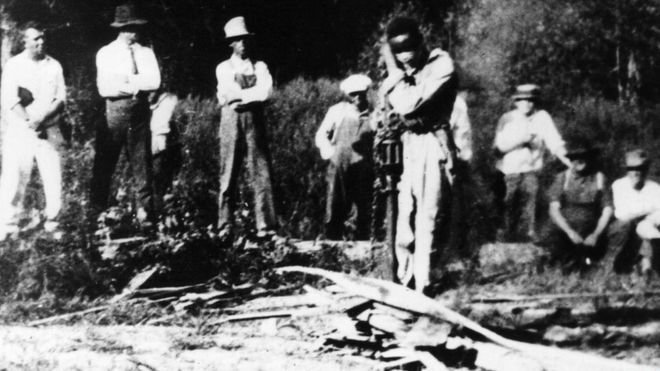
White lynch mob surrounds black man (Georgia, US, 1925)
Lynching had previously been treated as a civil rights offence
until the US Senate passed the bill this week
The United States Senate has unanimously approved a bill to make
lynching a federal crime in the country.

Three black senators introduced the bill in June to allow
lynching to be charged as a hate crime alongside existing crimes
such as murder.

For much of US history, lynchings were rarely prosecuted at
all.

More than 200 anti-lynching bills have been introduced to
Congress since 1918, all of which have been voted down.

Lynching is murder by a mob with no due process or rule of law.
In the US South in the 19th and 20th Centuries, thousands of
African Americans were lynched by white mobs, often by hanging.

In a tweet, Senator Kamala Harris – one of the bill’s architects
– said the vote was

“history.”Twitter post by @SenKamalaHarris: The moment when the United States Senate agreed unanimously to make lynching a federal crime for the first time. History.

‘This stain on our country’s history’
The bill was a bipartisan effort. It was first introduced earlier
this year by Ms Harris and Cory Booker – both Democrats – and by
Republican Senator Tim Scott.

According to the text of the bill, at least 4,742 people were
reported lynched in the US between 1882 and 1968. It says 99% of
all perpetrators had escaped punishment and called lynching “the
ultimate expression of racism in the United States”.

“Today, we have righted that wrong and taken corrective action
that recognizes this stain on our country’s history,” Booker said
in a statement following the vote on Wednesday.

Image copyrightGETTY IMAGES
Image caption
Democrat Cory Booker was one of three senators to introduce the
anti-lynching bill in June
The bill needed the backing of 60 Senators to pass. All 100 members
voted in favour of the bill including Bernie Sanders, the former
Democrat presidential contender, and Kentucky Republican Mitch
McConnell, the Senator Majority Leader.

“I thought we did that many years ago,” Mr McConnell said
earlier this year in an interview with Sirius XM radio. “If we need
one at the federal level, I certainly will support it,” he
said.

Presiding over the vote was Senator Cindy Hyde-Smith, a
Mississippi Republican who stirred controversy last month after
joking that she would attend a “public hanging” if invited by a
supporter.

The first anti-lynching bill was introduced to Congress 100
years ago by Republican Representative Leonidas Dyer of Missouri.
The bill passed the House but was opposed by Democratic senators
from southern states and failed to pass the Senate.

In 2005, the Senate passed a rare resolution apologising for the
repeated failure to approve anti-lynching legislation. The
bi-partisan resolution was backed by 90 members of the Senate out
of 100.

“Notwithstanding the Senate’s apology and the heightened
awareness and education about the nation’s legacy with lynching, it
is wholly necessary and appropriate for the Congress to enact
legislation, after 100 years of unsuccessful legislative efforts,
finally to make lynching a federal hate crime,” the bill says.

A memorial to the victims of lynching was unveiled in the city
of Montgomery, Alabama in April, the New York Times reports.

Related Topics

Post Views: 7

Read more

By admin

You missed

From Tramadol to Canadian to Exol-5 The New Drug Destroying Nigerian Youths An Investigative Article .From Tramadol to Canadian to Exol-5: The New Drug Destroying Nigerian Youths An Investigative Report on the Shifting Landscape of Substance Abuse in Nigeria Nigeria faces a severe and evolving drug crisis, particularly among its youth. What began with the widespread abuse of Tramadol has progressed through mixtures like “Canadian” to newer pharmaceutical diversions such as Exol-5. This shift reflects deeper issues: easy access to prescription drugs, weak regulation, socioeconomic pressures, and aggressive street-level marketing. NDLEA operations and health studies reveal a public health emergency that threatens an entire generation. Phase 1: The Tramadol Epidemic (2010s–Early 2020s) Tramadol, a synthetic opioid prescribed for moderate to severe pain, became Nigeria’s most notorious street drug. Cheap, potent, and widely smuggled (often from India and other Asian countries), it offered users energy, euphoria, and pain relief — appealing to commercial drivers, laborers, students, and young men seeking confidence or stamina. Scale of the Problem: Millions of tablets seized annually by NDLEA. High prevalence among young males aged 15–35. Linked to increased crime, sexual violence, organ damage (kidney failure, seizures), and mental health breakdowns. Contributed to broader opioid misuse alongside codeine cough syrups. Government responses included tighter import controls and public awareness campaigns, but these only displaced demand to other substances rather than eliminating it. Phase 2: The Rise of “Canadian” (Mid-2020s) “Canadian” or “Canadian Loud” emerged as a popular code for high-grade cannabis (often indica-dominant strains) or cannabis mixed with other synthetics. It gained traction as users sought alternatives or combinations to Tramadol’s effects. This phase marked a move toward imported or locally cultivated premium weed, sometimes laced with stronger chemicals. Youths in urban centers like Lagos, Kano, Jos, and Onitsha embraced it for its perceived “cleaner” high compared to opioids. However, it fueled polydrug use — combining cannabis with opioids, sedatives, or alcohol — amplifying health risks. Phase 3: Exol-5 – The Current Threat (2024–2026) Exol-5 (Benzhexol Hydrochloride / Trihexyphenidyl 5mg), originally a prescription medication for Parkinson’s disease and drug-induced movement disorders, has become the latest pharmaceutical being heavily abused. Why Exol-5? Euphoric Effects: Users report intense euphoria, hallucinations, and a sense of detachment — making it attractive as a cheap “upper” or escape. Accessibility: Sold over-the-counter or on the black market despite being a controlled prescription drug. NDLEA has seized millions of pills in single operations (e.g., 3.1 million pills in Kano in late 2024, and over 5.6 million combined with Tramadol in other busts). Street Names: Exol, Artane, Benzhexol, “Farin Mallam” (in Northern Nigeria). Demographics: Prevalent among youths, laborers, and even psychiatric patients who divert prescriptions. Studies show abuse rates as high as 25% among certain outpatient groups. Health Consequences: Anticholinergic toxicity: Confusion, dry mouth, blurred vision, urinary retention, constipation, and in high doses — delirium, psychosis, seizures, and heart issues. Long-term: Cognitive impairment, addiction, exacerbated mental health disorders. Often mixed with Tramadol, codeine, or cannabis, creating dangerous synergies. In cities like Jos, Exol-5 sits alongside diazepam, Rohypnol, and Tramadol on street markets, easily available to teenagers and young adults. Why This Evolution Continues Supply-Side Failures: Porous borders, corrupt officials, and overproduction of pharmaceuticals enable diversion. Demand Drivers: Unemployment, poverty, peer pressure, trauma, and the pursuit of performance enhancement (e.g., for “hustle” culture). Weak Regulation: Many pharmacies sell restricted drugs without prescriptions. Online and street vendors fill gaps. Displacement Effect: Cracking down on one substance (Tramadol/codeine) pushes users and dealers toward the next available option. NDLEA reports ongoing large seizures, but the problem persists due to high profitability and low risk for mid-level distributors. Broader Impacts on Nigerian Youths Education: Increased dropout rates and poor academic performance. Mental Health: Rising cases of psychosis and depression. Economy: Lost productivity among the working-age population. Crime and Violence: Drug-fueled robberies, cultism, and family breakdowns. Public Health System Strain: Overburdened hospitals treating overdoses and chronic complications. Young people aged 15–39 remain the hardest hit, with national surveys showing drug use prevalence significantly above global averages. What Must Be Done Stronger Enforcement: Consistent prosecution of corrupt enablers and large-scale traffickers. Regulation: Crackdown on rogue pharmacies and better tracking of prescription drugs. Prevention & Rehabilitation: School programs, community outreach, and expanded treatment centers (currently woefully inadequate). Economic Alternatives: Address root causes like youth unemployment. Public Awareness: Honest campaigns highlighting real dangers of “Exol-5” and similar drugs. Conclusion From Tramadol’s opioid grip to “Canadian” cannabis culture and now Exol-5’s anticholinergic highs, Nigeria’s drug crisis is mutating faster than responses can contain it. Exol-5 represents the dangerous new frontier — a legitimate medicine turned youth destroyer due to misuse and greed. Without urgent, multi-layered intervention — combining supply disruption, demand reduction, and socioeconomic support — an entire generation risks being lost to addiction. The time for half-measures is over. Nigeria’s future depends on winning this fight.